
Why Businesses Are Booking Holiday Events Earlier Than Ever Before
Look at December 2026 on a calendar and the problem explains itself. There are three weekends before Christmas week: the 4th and 5th, the 11th and 12th, and the 18th and 19th. Add the Thursdays that lead into them, the 3rd, the 10th and the 17th, and you have roughly nine nights that most companies would consider ideal for a holiday party. Every business in Metro Vancouver planning a December celebration is choosing from those same nine nights, and the venues, caterers and experience providers serving them are all working from that same short list.
That is the whole story behind the trend. Holiday bookings have been shifting earlier for a few years now, and the companies that treat late summer as planning season are the ones that end up with the date, the room and the experience they actually wanted.
The company party came back, and it came back bigger
For a few years after 2020 it was reasonable to assume the corporate holiday party was quietly fading. The data since then says the opposite. ezCater’s holiday party report, published in November 2025 from a survey of American employees and business decision makers, found that 82 percent of workers planned to attend their company celebration, up from 70 percent the year before. Ninety two percent of employers planned to fund a celebration, and 51 percent said they would spend more than they had the previous year.
Those figures are American, so treat them as direction rather than local fact. The direction is not really in dispute. More companies are hosting, more people are turning up, and budgets went up rather than down. When demand rises against a supply of nights that cannot grow, the booking window moves earlier. There is no other way for the market to settle it.
Budget cycles set the timeline, not festive enthusiasm
The second reason has nothing to do with the season at all. Most companies approve December spending during the third quarter, which means the person handling the party often has a confirmed budget by late August or September. Once the money is approved there is no reason to wait, and a good deal of reason not to. Waiting only shortens the list of what is still available.
Hybrid and distributed teams have added another layer. When part of the team works remotely or lives outside the city, the date is not just a date. People book flights, arrange childcare and fill their own December calendars quickly. A party announced in early October gets a strong turnout. The same party announced in mid November is competing with everything else people have already committed to.
More events, not just larger ones
Company celebrations have also been splitting into smaller pieces. Tagvenue’s event booking trends report from April 2026 noted that 63 percent of planners were seeing growing demand for gatherings of 20 to 100 guests rather than one large function. In practice that often looks like a department dinner, a client appreciation evening and a team celebration instead of a single all company night.
For the calendar, this matters more than it first appears. Three smaller events take three separate slots, usually on the same handful of desirable nights, and each one needs its own venue, catering and entertainment. The number of bookings competing for early December has grown even where the number of guests has not.
The part that surprises people: the experience needs lead time too
Most planners expect the venue to go first. Fewer expect the same of the entertainment, and that is where late bookings tend to get caught. A photo booth company has a fixed number of booths and a fixed number of attendants. On the second Saturday of December every unit is out and every attendant is working. There is no version of this business that scales up for one night, which is exactly why December dates close earlier than any other part of the year.
Holiday experiences add a second constraint on top of that one. The seasonal experiences at Off The Reel are built sets and custom software, not a booth with a garland draped over it, and they are allocated to dates rather than pulled off a shelf.
- Santa’s Workshop Booth. Guests step up to a holiday backdrop, choose a job title such as Chief Cookie Taster or Reindeer Trainer, and walk away with a personalized North Pole ID card carrying their name, their portrait and a Nice List badge, printed to wear or sent digitally to share.
- Magical Sleigh Ride. Guests hop onto the sleigh inside a set built with twinkling lights, snowfall effects and festive decoration, then receive photos and video with snow effects and sparkling overlays by QR code, text or email.
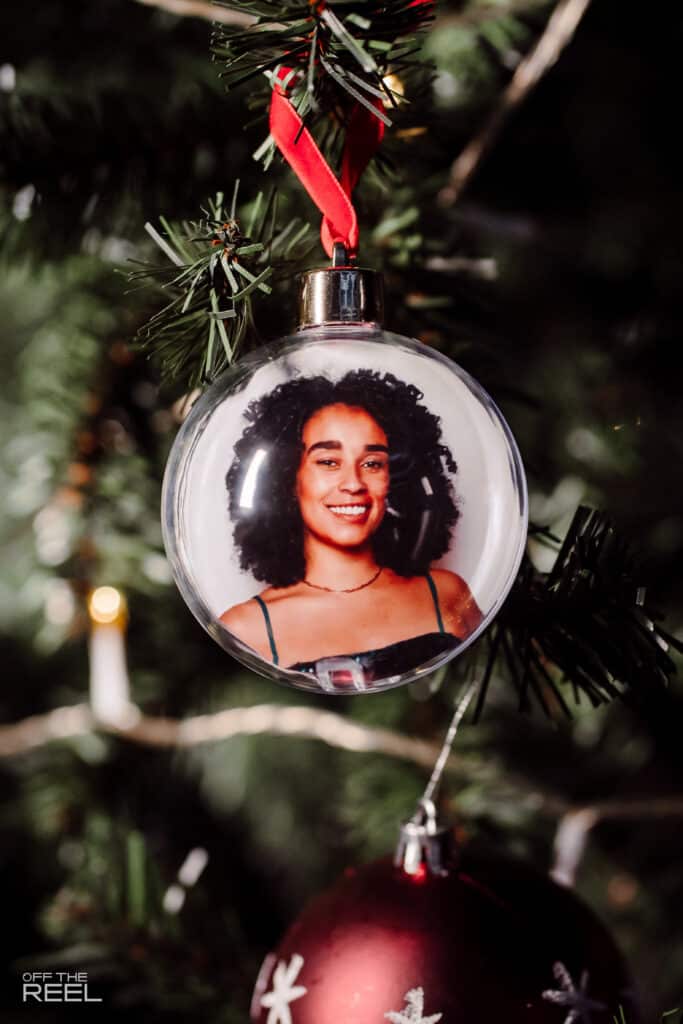
- Seasonal activations. The Naughty and Nice Card, The Gift, Holiday Constellation, The Holiday Bauble, Holiday Mail, Holiday Gazette, Midnight Ballroom and The Festive Present each run as their own interactive moment, with guests taking part rather than simply posing.
- Formats. Digital booth, print booth, 360 video and roaming experiences suit different rooms and different flows, which is a decision worth making before the floor plan is locked rather than after.
Every one of those can carry your branding, from logos and event names to themed overlays on the images guests take home. That artwork needs design time, approval time and production time. A booking made three weeks out can still be a very good night. It just cannot easily be a branded one.

For corporate events, the booth is doing two jobs
At a private party the photo booth is entertainment. At a corporate event it is entertainment that also happens to be a brand moment, which is a reason to give it more thought than it usually gets in the last fortnight of planning. Guests leave with a branded print, a keepsake that stays on a desk or a fridge rather than going in a bag. They share images to their own networks while the event is still running. Features such as Spin to Win give guests a reason to interact with branded swag or offers, and the sharing step can be set up to capture emails with the guest’s consent, which turns an evening of photos into something the marketing team can still use in February.
None of that assembles itself the week before. It is a short conversation in October and a straightforward build in November.
A realistic planning timeline for a December event in Vancouver
August and September are for the two decisions everything else depends on: the date and the venue. Lock those and the rest of the plan has something to attach to. September and October are for catering and for choosing the experience, since the seasonal sets and the attendants who run them are working from the same December calendar as the venues.
October is the right time for invitations, dietary requirements and transport, particularly if people are travelling in. November is for final head counts and for any branded overlays, custom backdrops or print templates, which need a couple of weeks to design, approve and produce. The first week of December is for the run sheet and the small details that make the night feel considered rather than assembled.
The short version
Holiday events are not being booked earlier because planners have become more anxious. They are being booked earlier because demand recovered, budgets are approved months ahead, events have multiplied, and December still only has three good weekends. Those four things all point the same way.
If you already have a date in mind, the useful next step is simply finding out whether it is still open. You can check your date at offthereel.ca, browse the full range of holiday experiences, or reach our team at 778-709-9917 and info@offthereel.ca. We will tell you honestly what is still available for the night you want, and what we would need from you to build it.